You are here: Home » News » Eyewear Business & Market Insights » Regional Preferences in Wholesale Glasses Frames: Market Trends & Buying Strategies Across Global Regions

Views: 0 Author: Matt Publish Time: 2026-01-07 Origin: Site


In the wholesale eyewear industry, one critical mistake can turn promising inventory into stagnant stock: assuming that what sells well in one market will perform equally in another. The reality is far more nuanced.
A metal aviator frame that flies off shelves in Miami might collect dust in Seoul. A minimalist acetate design that European retailers reorder monthly could seem too plain for Middle Eastern buyers seeking statement pieces. These aren't isolated incidents—they're systematic patterns that separate profitable wholesalers from those struggling with overstock.
The core challenge: Different markets don't follow the same selection logic. The same frame style can experience dramatically different sales velocities across regions due to variations in:
· Cultural aesthetic preferences
· Facial structure and fit requirements
· Climate and lifestyle factors
· Price sensitivity levels
· Sustainability consciousness
When wholesalers mismatch inventory to market preferences, the result is predictable: slow-moving stock, discounting pressure, and reduced profitability. Understanding these regional nuances isn't just helpful—it's essential for maintaining healthy inventory turnover and maximizing returns.
This guide breaks down the key differences in eyewear preferences across major global markets, providing actionable insights for wholesale buyers managing multi-region distribution.
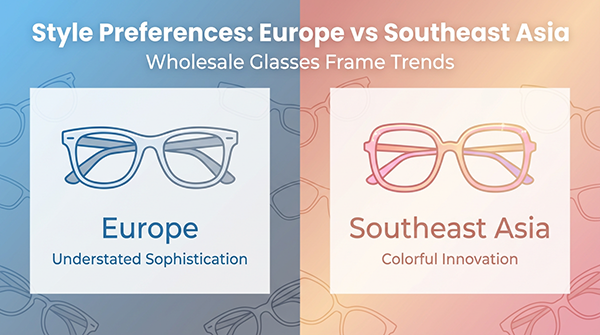
The contrast between European and Southeast Asian eyewear markets illustrates how dramatically preferences can diverge between regions with distinct aesthetic traditions and physical characteristics.
Europe gravitates toward understated sophistication. The market favors clean lines, neutral colors, and timeless designs that complement rather than dominate. Think minimalist metal frames in matte finishes, slim acetate rectangles in tortoise or black, and subtle geometric shapes. Bold colors and heavy embellishments typically underperform except in specific fashion-forward segments.
Recommended stock for European buyers: Classic wayfarers in acetate, slim metal aviators, and round vintage-inspired frames with clean finishes perform consistently well across Western European markets.
Southeast Asia embraces color, experimentation, and trend-driven designs. Younger demographics drive market preferences here, with strong demand for oversized frames, translucent acetates in pastels, two-tone color combinations, and designs influenced by K-pop and Asian fashion trends. The market refreshes styles more frequently than Europe.
Recommended stock for Southeast Asian buyers: Oversized acetate frames with Asian fit specifications, colorful transparent designs, and Korean-style metal frames with decorative details see strong reorder rates.
This is where regional differences become most critical—and where many wholesalers make costly mistakes.
Europe operates primarily on standard Western fit parameters:
· Bridge widths: 16-19mm (standard)
· Temple lengths: 140-145mm
· Frame widths: Medium to medium-large
· Nose pad design: Fixed or minimally adjustable
Southeast Asia requires specific fit considerations:
· Asian fit specifications are essential: Lower nose bridges (typically 18-21mm), higher nose pads, and adjusted frame curves
· Wider temples to accommodate different head shapes
· Many customers specifically search for "Asian fit" or will experience discomfort with standard Western sizing
Critical insight: Failing to stock Asian fit options in Southeast Asian markets directly impacts sales. Standard fit frames often slide down, pinch at the temples, or rest on cheeks—leading to returns and negative retailer feedback.
Stock recommendation: When targeting Southeast Asian markets, ensure 60-70% of your inventory includes Asian fit specifications or adjustable nose pads.
Europe leads in sustainability consciousness. Buyers increasingly request:
· Bio-based acetate from renewable sources
· Recycled metal frames
· Eco-certifications and transparent supply chains
· Lightweight titanium and stainless steel
This isn't just marketing—European retailers report that sustainability credentials influence purchasing decisions and justify premium pricing.
Southeast Asia prioritizes durability and value:
· Quality acetate that withstands humid climates
· Corrosion-resistant metal alloys
· Strong hinges for extended wear
· Cost-effectiveness over eco-positioning
While sustainability awareness is growing, it typically ranks below price and durability in purchasing criteria.

The Middle Eastern eyewear market represents a high-value opportunity that many wholesalers overlook due to lower search volumes and less readily available market intelligence. However, this region offers some of the strongest profit margins in wholesale eyewear.
Middle Eastern buyers show strong preference for premium positioning:
· Higher average unit prices compared to other regions
· Strong brand consciousness—even in wholesale contexts
· Preference for frames that signal quality and status
· Luxury finishes and premium materials outperform budget options
Unlike price-sensitive markets, attempting to compete on low cost in the Middle East often backfires. Buyers question quality when prices seem too low.
Stock recommendation: Focus on mid-to-high-tier metal frames with premium finishes—gold plating, titanium construction, and luxury acetate perform exceptionally well.
Metal frames dominate Middle Eastern sales, particularly:
· Gold-tone and rose gold finishes
· Geometric and angular designs
· Frames with subtle embellishments or branded details
· Aviator styles remain perennially popular
Design elements that resonate:
· Clean metalwork with decorative temples
· Layered metals or two-tone combinations
· Frames that make a statement without being overly bold
· Quality electroplating that maintains finish in hot climates
Acetate frames sell, but typically in more structured, formal styles rather than casual or overly trendy designs.
The Middle Eastern market shows distinct gender dynamics:
Men's eyewear represents a larger market share than in Western countries, with specific preferences:
· Larger, more substantial frames
· Metal constructions
· Conservative colors with occasional gold accents
· Professional and executive styling
Women's frames see demand for:
· Cat-eye and oversized styles
· Frames with decorative temples
· Both metal and premium acetate
· Lighter colors including pastels
Understanding these gendered preferences helps optimize inventory allocation—men's styles should represent a higher percentage of Middle Eastern stock compared to Western market distributions.
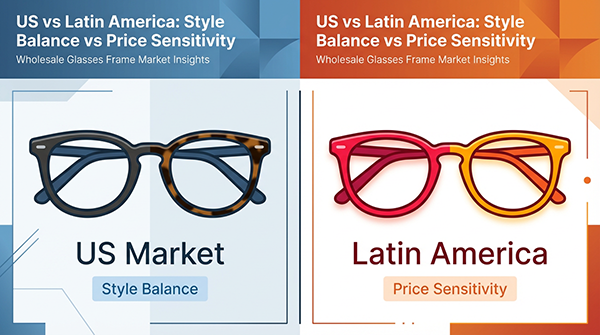
The Americas present two distinct market personalities that require different wholesale approaches.
The US market seeks balance between fashion and functionality:
Style characteristics:
· Versatile designs that work across multiple settings
· Neutral bestsellers: Black, tortoise, navy, clear acetate
· Trend awareness without extreme fashion-forward designs
· Strong demand for unisex and gender-neutral styles
Popular categories:
· Classic wayfarers and aviators (consistent performers)
· Minimalist metal rounds
· Contemporary rectangles
· Retro-inspired styles with modern updates
The US market appreciates quality but isn't necessarily premium-focused—mid-range positioning typically performs best for wholesale volumes.
Stock recommendation: Focus on bestseller basics with 70-80% inventory in proven neutral styles, reserving 20-30% for trend-responsive designs. Standard Western fit applies.
Latin American markets demonstrate greater style boldness combined with higher price sensitivity:
Style preferences:
· Brighter colors and bolder patterns
· Larger frame sizes
· More decorative elements
· Fashion-forward designs inspired by US/European trends
Economic considerations:
· Price points significantly impact purchase decisions
· Value perception matters more than premium positioning
· Durable construction essential—frames need longevity
· Competition from ultra-low-cost alternatives
Regional variations: Mexico shows different preferences than Brazil or Argentina—successful wholesalers research specific country dynamics rather than treating Latin America as homogeneous.
United States:
· Balanced between physical retail and online
· Predictable reorder patterns
· Seasonal buying aligned with fashion cycles
· B2B buyers expect reliable stock availability
Latin America:
· Stronger emphasis on physical retail relationships
· Less predictable reorder timing (economic factors)
· Bulk buying during favorable exchange rates
· Longer payment terms often expected
These operational differences influence how you structure wholesale relationships and inventory planning for each region.
Frame fit isn't just about comfort—it's about sales velocity. Frames that don't fit properly don't sell, period. Understanding regional sizing requirements prevents one of the costliest wholesale mistakes.
The Asian Fit vs Standard Fit distinction matters enormously:
Asian Fit specifications:
· Bridge height: 18-21mm (elevated)
· Nose pads: Raised and adjustable
· Temple curve: Modified for broader temples
· Frame angle: Adjusted to prevent cheek contact
· Markets requiring Asian fit: Southeast Asia, East Asia, parts of Central Asia
Standard Western Fit:
· Bridge height: 16-19mm (standard)
· Nose pads: Lower or integrated into frame
· Temple curve: Standard Western head measurements
· Markets using standard fit: Europe, Americas, Middle East, Australia
Critical mistake to avoid: Sending standard fit inventory to Asian markets or assuming "adjustable nose pads" solves all fit issues. Asian fit involves multiple design modifications beyond just nose pad height.
Hybrid solution: Some manufacturers offer "universal fit" frames with highly adjustable nose pads and modified curves that work across regions—these reduce SKU complexity when targeting multiple markets.
Unisex frames reduce inventory complexity, but they don't work equally well in all markets:
Markets favoring unisex designs:
· United States (strong preference)
· Northern Europe
· Australia
Markets with stronger gender differentiation:
· Middle East (distinct male/female preferences)
· Latin America (more traditional gender styling)
· Parts of Southern Europe
Effective unisex characteristics:
· Medium sizing (52-54mm lens width)
· Neutral shapes (rounds, soft rectangles, aviators)
· Versatile colors (black, tortoise, clear, navy)
· Balanced proportions without overtly masculine or feminine cues
When done correctly, unisex frames reduce SKU count while maintaining broad appeal—but don't force this approach in markets that prefer gender-specific styling.
Market Factor | Europe | Southeast Asia | Middle East | United States | Latin America |
Style Preference | Minimalist, classic | Colorful, trendy | Premium, statement | Versatile, balanced | Bold, decorative |
Fit Requirement | Standard Western | Asian fit essential | Standard Western | Standard Western | Standard Western |
Material Priority | Sustainability, bio-acetate | Durability, value | Premium metals, quality | Quality mid-range | Cost-effective durability |
Color Preferences | Neutrals, earth tones | Pastels, brights | Gold tones, blacks | Neutrals, tortoise | Vibrant colors |
Frame Size | Medium-large | Small-medium (Asian fit) | Medium-large | Medium-large | Large |
Price Sensitivity | Medium (value + eco) | High | Low (premium focus) | Medium | High |
Gender Styling | Increasingly unisex | Trend-driven both | Strong differentiation | Unisex popular | Moderate differentiation |
Top Sellers | Slim metals, classic acetate | Oversized acetate, K-style | Metal aviators, geometrics | Wayfarers, rounds | Bold acetate, large frames |
Sustainability Importance | Very high | Low-medium | Low | Medium | Low |
Reorder Pattern | Predictable, seasonal | Fast trend cycles | Stable, premium focus | Regular, reliable | Economic-dependent |
How to use this table: Identify your target markets, then align 70-80% of your inventory to the dominant preferences while reserving 20-30% for secondary trends and testing.
Understanding regional economics transforms how you structure wholesale offerings and manage inventory cycles.
Low price sensitivity (premium markets):
· Middle East: Focus on quality and finish over cost. Premium positioning outperforms budget options.
· Western Europe (selective segments): Sustainability and craftsmanship justify higher prices.
Strategy: Offer fewer SKUs at higher quality tiers with superior finishes and materials.
High price sensitivity (value markets):
· Latin America: Price point strongly influences purchase decisions
· Southeast Asia: Balance between trending styles and affordability
· Eastern Europe: Value consciousness with growing quality expectations
Strategy: Emphasize cost-per-wear durability, offer volume discounts, and maintain competitive pricing without sacrificing essential quality.
Balanced markets:
· United States: Wide range from budget to premium, with mid-tier performing best for volume
· Australia/Canada: Similar to US with slight premium shift
Strategy: Offer tiered options allowing retailers to target multiple customer segments.
Fast reorder cycles:
· Southeast Asia: 4-6 week trend-driven cycles
· US online retailers: Monthly restocking of bestsellers
Stock management: Maintain backup inventory of proven styles; be prepared for rapid shifts in trend items.
Slow, stable reorders:
· Middle East: Quarterly or seasonal orders of established styles
· Europe: Seasonal buying with classic styles seeing year-round demand
Stock management: Larger initial orders with less frequent replenishment; focus on timeless designs.
Economic-dependent patterns:
· Latin America: Irregular patterns influenced by currency fluctuations and economic conditions
Stock management: Flexible terms; maintain relationships during slow periods; be prepared for bulk orders during favorable conditions.
Bestseller identification varies by market:
· US/Europe: Data-driven with 3-month performance windows
· Southeast Asia: Social media trends and influencer impact
· Middle East: Word-of-mouth and repeat customer loyalty
· Latin America: Regional showroom events and trade shows
Understanding these patterns prevents overstock in slow markets and stockouts in fast-moving regions.
Successfully managing wholesale eyewear across multiple regions requires systematic market intelligence and strategic inventory planning.
Trade shows and exhibitions:
· Mido (Milan): European market trends
· Hong Kong Optical Fair: Asian market insights
· Vision Expo (US): American market directions
· Middle East regional shows: Gulf market preferences
Attend or monitor show reports to identify emerging patterns before they reach mainstream adoption.
Social media intelligence:
· Instagram/Pinterest: US and European trend spotting
· Xiaohongshu (Little Red Book): Chinese and Southeast Asian preferences
· TikTok: Youth market trends globally
· Regional fashion bloggers: Local style influencers
Track hashtags related to eyewear in your target markets (#eyewearstyle, #glasses, regional equivalents).
Retail sales data:
· Request bestseller reports from your existing retail customers
· Analyze which styles reorder most frequently by region
· Track seasonal variations in different markets
· Monitor return rates for fit and style issues
On-the-ground research:
· Visit retail locations in target markets when possible
· Photograph popular styles being worn locally
· Note which frames appear in local advertising
· Observe demographic wearing patterns
Industry reports and market research:
· Subscribe to eyewear industry publications
· Review market analysis reports (even paid reports offer valuable insights)
· Join wholesale buyer forums and communities
· Network with manufacturers serving your target regions
Smart multi-region buying reduces per-unit costs while minimizing regional mismatch risks:
The 70-30 inventory rule:
· 70% regionally specific inventory (Asian fit for Asia, premium metals for Middle East, etc.)
· 30% universal bestsellers that perform across markets (classic aviators, neutral wayfarers)
This balance lets you consolidate orders for volume discounts while maintaining regional optimization.
Shared universal styles to order in bulk:
· Black acetate wayfarers (standard fit for Western markets)
· Metal aviators with neutral finishes
· Tortoise rectangles
· Clear/transparent frames (trending globally)
Order sequencing strategy:
1. Start with proven universal styles: These form your base inventory across all markets
2. Add regional must-haves: Asian fit for Asia, premium metals for Middle East
3. Reserve 10-15% for regional trend tests: Smaller quantities of market-specific trends
4. Plan backup stock: Deeper inventory of confirmed bestsellers by region
MOQ management for multiple regions:
· Some suppliers offer mixed container options
· Negotiate flexible MOQs by demonstrating total volume across regions
· Consider partnering with another wholesaler to split region-specific orders
· Use stock service suppliers for smaller test quantities before committing to full production runs
Example multi-region order structure:
· 1,000 units universal classics: Split across all markets
· 500 units Asian fit: Entirely for Southeast Asian customers
· 300 units premium metal: Focused on Middle East
· 200 units bold acetate: Latin American distribution
Not all eyewear suppliers can effectively serve multi-region wholesalers. Look for these capabilities:
Manufacturing flexibility:
· Can produce both Asian fit and standard fit from the same design
· Offers adjustable nose pad options without major price premiums
· Maintains quality consistency across different specification types
Size range capabilities:
· Provides comprehensive sizing (small, medium, large) within style families
· Can modify bridge widths and temple lengths per market requirements
· Offers children's and oversized options if your markets require them
Material versatility:
· Sources both eco-friendly materials (for European buyers) and cost-effective options (for price-sensitive markets)
· Maintains finish quality across climate variations (humid Asia, hot Middle East)
· Offers multiple metal allergy-safe options (nickel-free, titanium)
Stock and reorder support:
· Maintains in-stock programs for bestsellers to enable quick reorders
· Offers reasonable minimum reorder quantities per style
· Provides backup stock options during peak seasons
· Can accommodate split shipments to different regional warehouses
Communication and market understanding:
· Understands regional fit and style differences (not all suppliers do)
· Provides market-specific product recommendations
· Offers samples in multiple fit specifications
· Responsive to urgent reorder needs
Questions to ask potential suppliers:
1. "Do you manufacture Asian fit specifications, and can you produce them alongside standard fit?"
2. "What are your reorder minimums for bestselling styles?"
3. "Can you provide material certifications for European sustainability requirements?"
4. "Do you maintain stock inventory, or is everything made-to-order?"
5. "What's your typical production timeline from order to shipping?"
6. "Can you ship to multiple destinations from a single order?"
The right supplier relationship significantly reduces the complexity of multi-region wholesale management.
In wholesale eyewear, regional differences aren't obstacles—they're opportunities for informed buyers to gain competitive advantage.
The wholesalers who thrive understand that profitable inventory management is built on four interconnected pillars:
Selection strategy: Matching frame styles to regional aesthetic preferences—minimalist for Europe, colorful for Southeast Asia, premium for Middle East, versatile for the US, bold for Latin America.
Sizing precision: Ensuring Asian fit availability where physically required and standard fit where appropriate, eliminating the single biggest source of returns and customer dissatisfaction.
Pricing alignment: Positioning premium in markets that value it, emphasizing value in price-sensitive regions, and finding the balance in moderate markets.
Reorder planning: Understanding regional sales cycles—from fast-moving Southeast Asian trends to stable Middle Eastern preferences—and maintaining inventory accordingly.
Ignore these regional nuances, and you'll face the classic wholesale trap: slow-moving inventory, forced discounting, and eroded margins. Embrace them, and you'll see faster turnover, stronger retailer relationships, and better profitability.
The strategic advantage comes down to this: While many wholesalers still treat eyewear as a commodity market competing purely on price, informed buyers recognize it as a market of regional preferences where knowledge creates value.
Whether you're expanding into new markets or refining your existing regional approach, the right product mix makes all the difference.
Our team specializes in helping wholesale buyers navigate regional preferences with:
· Curated stock selections matched to your target markets
· Asian fit and standard fit options across our entire range
· Flexible order structures supporting multi-region strategies
· Fast reorder capabilities on bestselling styles
· Private label solutions tailored to specific market requirements
Contact us to discuss which models and specifications best match your regional distribution strategy. Our product specialists understand the nuances covered in this guide and can recommend optimal inventory combinations for your specific market mix.
Get in touch today to receive market-specific product recommendations and discuss how our stock programs can support your multi-region wholesale needs.


