You are here: Home » News » Eyewear Buying Guides » Most Comfortable Glasses Frames: How to Choose the Right Fit for All-Day Wear

Views: 0 Author: Matt Publish Time: 2025-12-20 Origin: Site


Finding the most comfortable glasses frames is no longer just about choosing the lightest pair. True comfort comes from a balanced combination of material selection, structural design, face shape compatibility, and real daily wearing scenarios.
For optical brands, wholesalers, and retailers, comfort-focused eyewear has become one of the strongest drivers of repeat purchases, lower return rates, and long-term customer loyalty. Consumers who wear glasses 8–14 hours a day are far more sensitive to comfort issues than to short-term fashion trends.
This comprehensive guide explains how to choose the most comfortable glasses frames for all-day wear, and why comfort-centered design matters for both end users and eyewear businesses.
Comfortable eyeglass frames should feel natural on the face. When the fit is correct, wearers often forget they are wearing glasses at all.
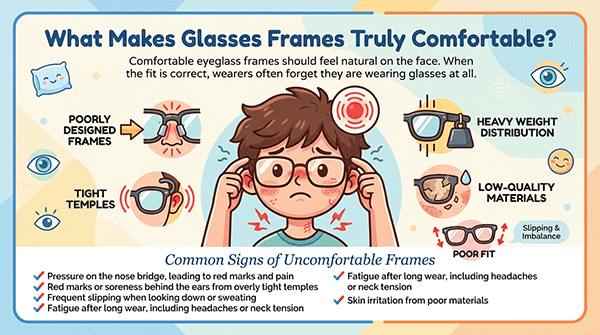
Poorly designed or ill-fitting frames usually cause:
Pressure on the nose bridge, leading to red marks and pain after short wear
Red marks or soreness behind the ears from overly tight temples
Frequent slipping when looking down or sweating
Fatigue after long wear, including headaches or neck tension
Skin irritation caused by poor materials or rough contact points
The most comfortable glasses frames are engineered to distribute weight evenly, stay stable without squeezing, and adapt to different facial structures.
Weight Distribution – Balanced pressure across the nose, ears, and temples
Contact Point Design – Smooth, adjustable surfaces where the frame touches the face
Structural Balance – Proper geometry that prevents forward tilting
Many consumers assume lighter frames automatically mean better comfort. In reality, weight distribution is more important than absolute weight.
A well-balanced frame:
Reduces nose pressure by up to 40–60%
Prevents forward sliding during head movement
Keeps lenses aligned with the optical center
Spreads load across multiple contact points
A poorly balanced 25-gram frame can feel heavier than a well-designed 30-gram frame.
For prescriptions above ±3.00 diopters, lens weight significantly affects comfort. High-index lenses can reduce thickness and weight by up to 30%. For prescriptions above ±6.00, lens weight often exceeds frame weight, making material and balance even more critical.
The ideal center of gravity sits slightly behind the nose bridge. Front-heavy designs create constant forward pressure, while well-balanced frames feel almost weightless during extended wear.
Material choice directly impacts long-term comfort, durability, and skin compatibility.
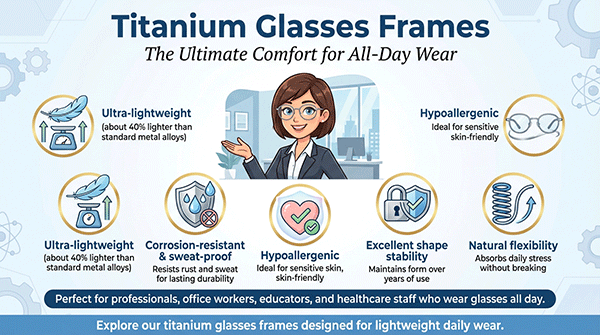
Titanium is widely regarded as one of the best materials for all-day comfort.
Key advantages:
Ultra-lightweight (about 40% lighter than standard metal alloys)
Corrosion-resistant and sweat-proof
Hypoallergenic, ideal for sensitive skin
Excellent shape stability over years of use
Natural flexibility that absorbs daily stress
Types of titanium:
Pure Titanium – Maximum lightness and biocompatibility
Beta Titanium – Higher flexibility, ideal for rimless and semi-rimless frames
Titanium Alloy – Balanced strength and cost efficiency
Titanium frames are ideal for professionals, office workers, educators, and healthcare staff who wear glasses all day.
Explore our titanium glasses frames designed for lightweight daily wear.
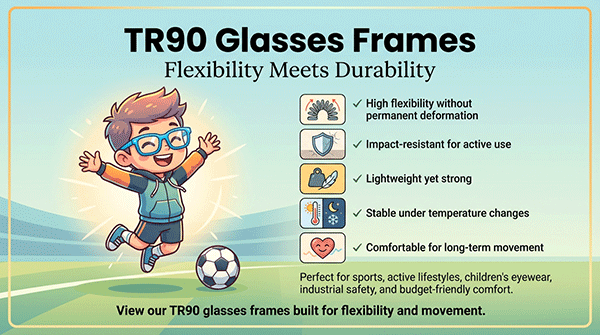
TR90 is a flexible memory polymer known for comfort and durability.
Advantages:
High flexibility without permanent deformation
Impact-resistant for active use
Lightweight yet strong
Stable under temperature changes
Comfortable for long-term movement
Best use cases:
Sports and active lifestyles
Children's eyewear
Industrial safety glasses
Budget-friendly comfort collections
View our TR90 glasses frames built for flexibility and movement.

Acetate frames are slightly heavier but offer unique comfort benefits.
Why acetate remains popular:
Smooth, skin-friendly natural surface
Adjustable with heat for precise fitting
Warm touch compared to metal frames
Excellent durability and aging resistance
Rich color and pattern options
Acetate frames are ideal for customers who value style without compromising comfort.
Stainless steel offers acceptable comfort at a lower cost but requires proper coatings.
Ultem (PEI) is an advanced thermoplastic used in aerospace, combining extreme lightness with chemical and heat resistance, positioned as a premium comfort material.
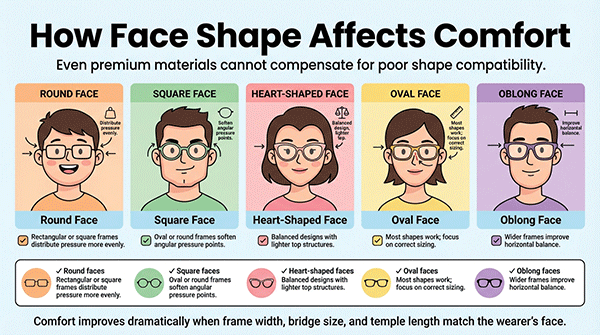
Even premium materials cannot compensate for poor shape compatibility.
Round faces: Rectangular or square frames distribute pressure more evenly
Square faces: Oval or round frames soften angular pressure points
Heart-shaped faces: Balanced designs with lighter top structures
Oval faces: Most shapes work; focus on correct sizing
Oblong faces: Wider frames improve horizontal balance
Comfort improves dramatically when frame width, bridge size, and temple length match the wearer’s face.
Many comfort complaints come from wearing frames not designed for specific facial structures.
Asian fit glasses frames are engineered for:
Lower nose bridges
Wider facial structures
Higher cheekbones
Flatter bridge profiles
Wider, higher nose pads for better pressure distribution
Modified frame curvature to reduce cheek contact
Adjusted temple angles and lengths
East Asian and Southeast Asian users
Anyone with a low nose bridge
Wearers experiencing constant slipping with standard frames
Discover our Asian fit glasses frames designed for low-bridge comfort.
Comfort is greatly improved through adjustability:
Silicone or air-cushion nose pads
Spring hinges for variable head widths
Soft temple tips and memory materials
Keyhole or saddle bridge designs
These features allow opticians to fine-tune fit for individual wearers.
Best choices:
Ultra-light titanium frames
Adjustable nose pads
Minimalist designs compatible with headsets
Best choices:
Flexible TR90 frames
Anti-slip nose pads
Secure wrap-around temples
Balanced acetate or beta titanium frames that remain stable during movement.
Children: TR90, rounded edges, ultra-lightweight designs
Teens & young adults: TR90 or thin metal frames balancing style and durability
Adults: Titanium or adjustable acetate for long workdays
Seniors: Ultra-light frames with soft contact points and easy handling
Comfort needs evolve with age as facial structure and skin sensitivity change.
A truly comfortable frame should:
Show no pressure points after 30 minutes
Stay stable when looking down
Cause no headaches or soreness
Feel “unnoticeable” during wear
If users constantly adjust or remove their glasses, comfort is insufficient.
From a business standpoint, comfort-driven eyewear offers:
Lower return rates (comfort issues cause up to 40% of returns)
Higher customer satisfaction and reviews
Stronger repeat purchase behavior
Ability to justify premium pricing
Clear product differentiation in crowded markets
Comfort is not just a feature—it is a long-term competitive advantage.
The most comfortable glasses frames result from thoughtful material selection, ergonomic design, and precise fit. Weight distribution matters more than absolute weight, and comfort priorities vary by lifestyle, age, and facial structure.
For eyewear brands and retailers, investing in comfort-focused frames directly improves customer loyalty and lifetime value.
Looking for comfortable glasses frames for your optical brand or retail business?
We offer:
Titanium, TR90, acetate & Asian fit optical frames
Stock models and OEM customization
Stable quality and flexible MOQ
Free samples for qualified buyers
Technical support and fitting guidance
Custo packaging and branding
Contact us today for catalogs, pricing, and comfort technology specifications.
Let's build eyewear that customers love to wear all day, every day.


